Board reports you can sign
Every AI system measured against the targets for its risk tier, frozen when it’s issued and signed off by a person. Nothing in it is written by AI.
When a board asks how the company’s AI is doing, the answer usually comes as a slide deck. Someone pulls numbers from a few dashboards, adds a screenshot or two, and writes a paragraph that sounds reassuring. By the time it reaches the meeting, nobody can say exactly where each number came from, or whether it would come out the same if you ran it again.
Tachana’s reports start from the other end. Tachana already keeps a record of every AI system you run: every output it checked, every flag, every decision a person made, and how long each one took. The report is that record.
Every Monday at 6 am
Each week, Tachana measures every AI system against the targets set for its risk tier. A high-risk system might need every held output decided within the hour. A low-risk one might only need a spot check each week. For each system and each target, the report says whether it was met.
When there are too few cases to judge a target fairly, the report says so, instead of counting it as met. The same report comes at the end of every month and every quarter.
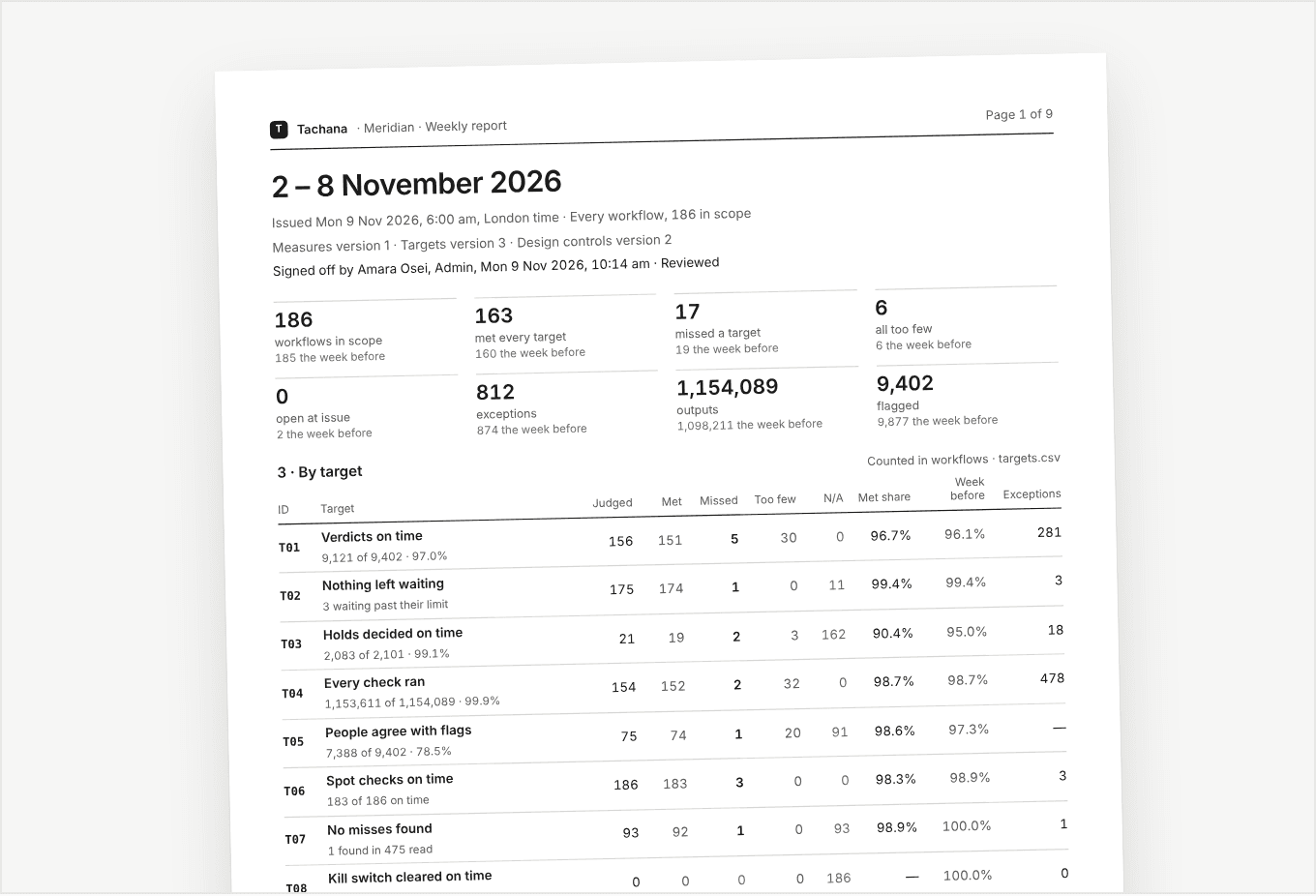
Frozen when it’s issued
At 6 am the week closes and the report is issued. From then on it can’t be changed. Each report carries a fingerprint, so anyone can check that the copy in the board pack is the one that was issued.
At 7 am it’s emailed to the people who need it, with the PDF, the CSV files and a JSON copy attached.
Signed off by a person
An admin reads the report and signs it off, and their name and the time go on it. Until then it’s marked as not yet signed off, so nobody mistakes it for the final word.
A board shouldn’t have to wonder whether the report about its AI was written by AI.
No words written by AI
There’s no summary written by a model anywhere in a Tachana report. Every number comes straight from the record, and the sentences around the numbers are fixed ones that you can check against them.
Two ways to read it
The same report reads two ways. By AI system, it shows which systems missed a target, and which one. By target, it shows how everything did on each: how many held outputs were decided in time, how many spot checks were done, how many checks ran.
What it maps to
Each target notes the clauses it’s evidence for in ISO/IEC 42001, the NIST AI Risk Management Framework, the EU AI Act and Australia’s Guidance for AI Adoption. That makes the report useful in an audit. It doesn’t certify anything: it’s evidence toward a clause, and your auditors decide what it’s worth.
- ISO/IEC 42001
- NIST AI RMF
- EU AI Act
- Guidance for AI Adoption
If you’d like to see a report built from AI like yours, talk to us. We’ll set up a demo, with last week’s report for a sample company in it.